Sunday, July 24, 2011

Neepawa


Yesterday, I was one of many visitors to Neepawa, with the 15th annual Lily Festival being the official occasion.

My reasons for visiting were different than those of the 28 other passengers and passengerettes on the bus. I had been there last year at this time and I was so impressed with the town that I wanted to go back. The townsfolk were very friendly and the people seem to take a great deal of pride in where they live. It is a pleasant and welcome change from what I call the degenerate capital of the Socialist People’s Republic of Manitoba.

The drive to Portage la Prairie, our morning break stop, that has become somewhat routine, did not pass without a couple of photographic highlights.


I missed this shot when I passed by this way a couple of weeks ago on the way to Clear Lake and I did not make that same mistake again.

Rest assured, the temporary closure of the Elie Esso has caused me no “inconveniance”.


Near Road 31W is the sign for Carli’s Produce. I think most of you know why this is significant for me.

I also learned that the person seated to my left once worked with Telly Mercury, who was the first legal counsel for Winnipeg Jets version 1.0 and who served on the team’s first board of directors. Needless to say, that one came out of left field.

After getting off the bus in Portage, I made my way over to Subway to pick up my lunch. The lunch in Neepawa was provided as part of our tour, but, from my experience last year, it was not a gastronomic misadventure I wanted to repeat. On the way to Subway, I noticed this sign:


It was unseasonably chilly on this day, so I guess someone did “eat the heat”.

I returned to the bus via the deserted Portage la Prairie Mall.

  
I understand that Portage la Prairie is doing well, but the same can not be said for the mall. Good space still available. Cheap.

Near the bus, I spotted this sign:


It would not be wise to add another partner with a name that starts with “K”.

Upon leaving Portage, we continued west until we reached PTH 16, otherwise known as the Yellowhead Highway.


We reached Neepawa safely, only to have our designated parking spot blocked by the route for the Lily Festival parade. Derek, our bus driver, had to carefully navigate through some narrow streets that were in worse shape than some I’ve seen in Winnipeg to find a different place to drop us off.

We eventually disembarked near the Legion, where I spotted this cannon aimed westward.


It’s comforting to know that this cannon stands ready to defend us from the invading hordes advancing from the Farmers Republic of Saskatchewan. Jack Chow, or Layton, would, of course, insist on this armament being registered.

I didn’t stick around to see the parade of farm implements, but I did take this shot before beginning my tour of the town:

  
This is the historic Land Titles Building:


An odd-shaped home at the corner of Hamilton Street and Walker Avenue:


Someone who lives at the corner of Brown Avenue and Mill Street is obviously a keen gardener, or gardenerette, whatever the case may be:


I stumbled upon Neepawa Collegiate:


… as well as the hospital, or “health center”, the new in-vogue term for a health care facility.


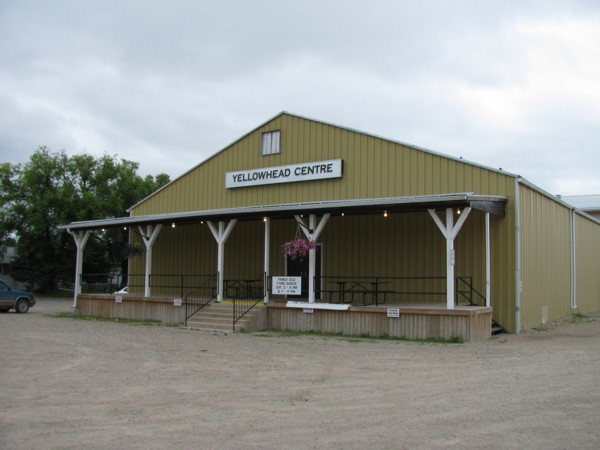
This is the Yellowhead Center and adjacent Yellowhead Arena, which was a former salt mine that closed in 1970. Prospectors originally hoped to find oil at this site, but they found salt instead.


This is the sign outside the Yellowhead Center. The editor in me noticed, as you would expect, that Margaret Laurence’s name was misspelled. She is perhaps the most famous person to have been born in Neepawa and her childhood home, a Manitoba Star Attraction, is a museum and writers’ resource center, making this an especially egregious error.


Leftovers from the parade:


The Viscount Cultural Center for the Arts might have been an interesting place to visit, but I was a little short on time.


As a person who can orient myself by the position of satellite dishes on people’s homes, I noticed that everyone who had a dish anywhere in town, not just those on this apartment block, were customers of Shaw Direct, formerly StarChoice.

  
This is the childhood home of Margaret Laurence, not “Lawrence” as the sign at the Yellowhead Center suggested.


This is the Neepawa Building, which was originally built to house federal government offices at a time when Neepawa was Manitoba’s third largest city.


My next stop was the Beautiful Plains County Courthouse, not just because of its historical significance in the area, but because I knew there was a washroom there.


For all the efforts that the town goes through to host the Lily Festival every year, the lack of available public washrooms is something I wish they would address. There was a portable toilet outside and a line almost 10 deep inside. Fortunately, from my experience last year waiting for someone who took so long in the washroom that I thought he fell asleep in there, I knew there was a washroom in the basement and I used that one. An embarrassing situation was narrowly averted when I walked into the men’s washroom to find a woman in there who didn’t lock the door behind her. She was on her way out, however.

Having unloaded the contents of my bladder, I noticed this sign:


What must the rest of the chicken weigh?

A visitor from the Farmers Republic of Saskatchewan, showing pride in his taxpayer-subsidized, semi-professional football team.


Green is the color. Football is the game. We’re all together. And winning is our aim. I’ll spare you the rest of the Saskatchewan National Anthem.

There was a nice garden outside the Knox Presbyterian Church, which was built in 1896.


Horse-drawn wagons are available for a tour around town:


Free fertilizer is also available on the route. Be careful not to step in it.

Most people of Neepawa seem quite happy to have visitors, but the Noonan-Robinson household is one exception:


This house was originally owned by the Davidson family, one of the early settlers in the area:


I wound up my tour of Neepawa with a stop at the Beautiful Plains Museum, a former CNR station:


Once inside, I realized that I wasn’t going to have enough time to see everything. From the outside, it doesn’t look like much, but for a history buff like myself, it’s a place I could have spent half a day or more in.


For starters, this was a nice shot from 1941 or 1942 of the approach to Neepawa from the east along what was then PTH 4, less than two decades after the trunk highway system in Manitoba was established. I did my best to capture the shot with my camera, but I wish I had my scanner with me.

I visited a number of other places inside the museum:


There was a display of license plates dating back to 1913:


Various photos and displays from the area’s sports history:


Neepawa was the host of an air force training base during World War II and they had a display of some military archives:


Later, during a guided tour of the town on our bus, we learned that there are some graves in Riverside Cemetery from some of the prospective pilots who perished during their training in Neepawa.

I only wish I had allowed for more time at the museum, but alas, I had to make my way to Mr. Ribs restaurant where our bus was waiting.


Your mileage may vary, but I literally paid not to eat there. Once burned, twice shy.

Next on the agenda was a guided tour of the town and we picked up Joe, a local resident, who took us around many of the spots I had covered on foot and provided a lot of useful historical detail on many of the places I had visited. The highlight was a trip through scenic Riverside Cemetery, but I imagine it wasn’t a highlight for Derek, who had to negotiate some difficult turns. It wasn’t a place built for large tour buses.

The tour wound up with an unscheduled drive-by of the bird sanctuary and park on the south end of town. The bird sanctuary in Souris is highly touted, but I had not heard of Neepawa’s refuge for our fine, feathered friends that more than rivals its equivalent in Souris. On my next visit, I will have to make a point of stopping there.

We dropped Joe off near the courthouse, and then it was on to the Lily Nook, a couple of miles south of Neepawa.


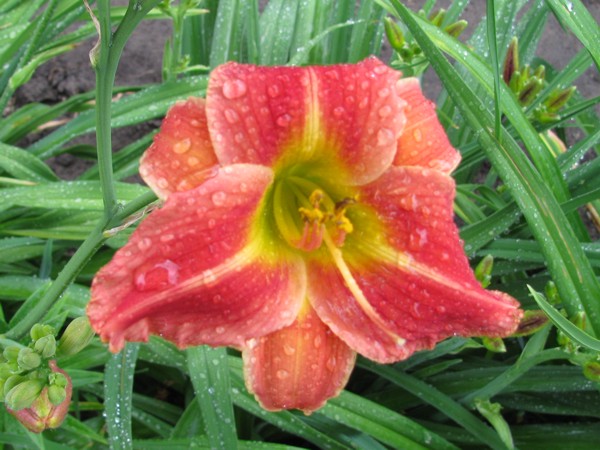
The Lily Nook is not located on the Yellowhead Highway, but I guess it’s close enough. Many of the people on the bus wanted to buy lilies, but I just came for the pictures. Fortunately, the rain held off until we left the Lily Nook.


The rain came down in buckets for most of our way back, and the traditional “pass the time” activity of bingo nearly put me to sleep. The afternoon stop was Portage la Prairie once again, and most of the bus’s occupants, including me, were anxious to go home. Everyone was back on the bus well ahead of schedule and we arrived safely back in the degenerate capital of the Socialist People’s Republic of Manitoba a short time later.

My thanks to Derek, who brought us there and back safely there, to Joe, our guide in Neepawa, for providing some valuable details on Neepawa, and to Roswitha, our tour guide for the fourth time in just over two weeks.

Friday, July 22, 2011

The Urban Legend That Won’t Die


Recently, I read a column by Ed Tait in the Liberal Party of Canada’s daily publication, better known to most of you as the Winnipeg Free Press.

In his column, Tait had this to say regarding former Edmonton Oiler Charlie Huddy, who had just accepted a position as an assistant to an assistant coach of Mark Chipman’s personal hockey team:

Huddy, after all, was part of that Oiler dynasty that forever stood in the way of any kind of Jets’ postseason success -- including that (in)famous 1990 series in which the Oil came back from a 3-1 deficit in a series against Winnipeg to win in seven and ultimately grab the last of their Stanley Cup titles.

“That Oiler dynasty that forever stood in the way of any kind of Jets’ postseason success,” was the specific line that got the hair on the back of my neck to stand on end.

John Ferguson, rest his soul, the larger-than-life figure who cast a long shadow over the Jets during his decade as the team’s general manager, would no doubt be comforted by those words. However, to keep blaming the Jets’ perennial playoff failures that began to border on comical on the fact that they were in the same division as the Oilers is perpetuating a myth that has no basis in fact.

The Jets hired John Ferguson as their Vice-President and General Manager in November 1978 and he remained in that position until October 1988 when Jets’ President Barry Shenkarow fired him before a home game against the Los Angeles Kings. Upon taking the job, Ferguson took over a largely shoestring operation and built it up to major-league standards. He played an important role in leading the Jets into the NHL, and for that, all Jets fans owe him a debt of gratitude. Through no fault of Ferguson’s, the Jets, along with the other three former WHA teams who joined the NHL in 1979, were stripped of most of their talent and entered the NHL with very little to build on.

Ferguson then began his “master plan” to rebuild the Jets into a championship contender though the draft. He worked tirelessly and remained remarkably patient through some lean years. His drafts brought some very talented players to Winnipeg and the Jets soon emerged from the depths of expansion to establish themselves as a team that no longer qualified as a soft touch on the schedule for visiting teams.

Unfortunately, the Jets’ path to contention stalled. They didn’t get any better.

Ferguson presided over the Jets for nine full NHL seasons. The Jets posted a winning record in only two of those nine seasons. After Ferguson’s dismissal, the Jets would go on to post three more winning seasons before leaving for Phoenix. In total, the Jets posted five winning records during their 17 seasons in the NHL.

This is not the resume of a successful, revered franchise.

Yes, the Jets always seemed to meet the Oilers come playoff time, and it was always the Oilers who came out on top. However, the Jets were always meeting the Oilers in the first round because they couldn’t separate themselves from the mediocre Calgary Flames and Vancouver Canucks to avoid meeting the Oilers.

Even if the Jets had managed to avoid meeting Edmonton in the first round, there’s no reason to believe that those Jets teams would have fared better against any other opponent. The Jets went down embarrassingly meekly in far too many of their playoff games. They had the talent to at least make the Oilers sweat and failed miserably to even do that much. Lesser teams at least made respectable showings when they visited Edmonton at playoff time.

No, the Oiler dynasty did not stand in the way of the Winnipeg Jets. It was the Winnipeg Jets who stood in the way of the Winnipeg Jets.

Saturday, July 16, 2011

Tacky Addition to Grace Hospice


As anyone who follows my site knows, Grace Hospice is very special to me, as it was the place where I spent the most time with Carli Ward. Carli had been diagnosed with terminal cancer in August 2006 at the age of 24 and she spent her final months of life at Grace Hospice, a free-standing palliative care facility on the grounds of Grace Hospital in west Winnipeg. I visited her often once she moved there on the first day of May 2007 up until her death on the morning of December 15 of that year.

Carli was treated exceptionally well at Grace Hospice and, in many respects, it was her best home. She had a difficult life, but she received the care she needed at the time she needed it the most and in a home-like setting. We are fortunate to have that facility as part of our health care system.

Despite the passage of time since Carli’s death, I make regular visits there to see her name up on the plaque at the memory garden as well as her name up on the “In Memoriam” wall inside Grace Hospital.

I haven’t forgotten Carli.

I never will.

During my most recent pilgrimage, however, I noticed some new additions to the parking lot.


This shot shows one of the parking stalls with a new sign in front of it that reads “Remember your stall number. Pay inside hospice.” All the parking stalls have the same signage, including the two stalls designated for use by the handicapped.

I was appalled.

I still am.

For those not familiar with the layout at Grace Hospital, there are separate parking lots for both the main hospital and for the hospice. The hospital is fair game for parking fees as far as I’m concerned, but the hospice is a completely different matter.

Carli spent seven and a half months there, but she was an exception. According to Jon Einarson, director of the Grace Hospital Foundation, the average stay at Grace Hospice is 30 days. Distraught family members and friends visiting their loved ones as they hover near death will now be pulling up to the parking lot only to be asked to dig out their wallets for the privilege of parking there, as if they don’t have enough on their minds.

In this situation, visitors should be encouraged. Strongly encouraged. Welcomed with open arms.

Now they’re being nickel-and-dimed.

And that’s tacky.

Really tacky.

Shame on the heartless bureaucrats who thought this was a good idea.